|
Breaking Apart a Drawing
|
|
Breaking Apart a Drawing
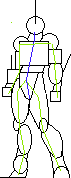
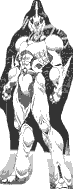
The most important thing I've learned thus far has been to never look at a picture as a whole until you've got all the parts worked out. This goes for pretty much everything. When you first approach a subject try and break down the pose into shapes, (you've probably heard this part before ^_^) because let's face it.
| This:
|
Looks alot less
intimidating than this:
|
Most people will stop there when they try and explain this aspect of drawing and that can be a pain in the butt since not everybody realizes that the same sort of technique can be apllied to the remainder of a drawing. To explain this better let me pic apart some of my Guyver work.
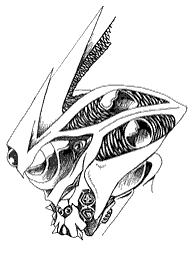 |
Now this guy was originaly
supposed to be the Gigantic Dark but I didn't have a good side view of him
when I drew it so it just ended up being.. well whatever the hell it is.
Now to stress my point about breaking the thing apart...
The reason this may look difficult is simple, you're looking at the entire picture. Try isolating a single area, the head beam for example (That's the round thing in the base of the fin over the forehead ~far left~ for you non-guyver fans). Up close all that it is is a circle that's been shadded to leave a highlight. Here's a better example for anyone who doesn't see what I'm talking about or you can click on parts of the image to the left to zoom in on some of them. |
| The same priciple can be used to break apart the rest of the drawing... The control medal (big round three-part object under the head beam) for example is composed of two wavy lines with shading to simulate a gradient under the second. The visual orbs(the round things on the back part of the head) are another good example of this type of shading. | |
Now the example above was done in pen and ink but the same things can be applied to any media. Isolate a section or an effect on a drawing or painting or cel or whatever and pick it apart, figure out how it fits and put it back together. You'd be surprised at the kinds of elaborate effects that are acheived through relatively simple processes.